On monopolies, part one.

In a comment on a recent post, Blonde wrote:

A look on our history as a country, not even taking into account the experiences of other states, is enough to show that times wherein the government did not play a significant role in regulations resulted in imperative issues of monopoly, unbalanced classes, and fiscal disaster save for a select few.

After informing her that she was generally wrong and that I was going to write a post-length response, she wrote:

Whoa whoa, you can’t just throw that in there with your parentheses and what not. How does lack of government regulations not add up to corporate monopolies, historically?

First, it’s my blog, and I’ll put parentheses around anything I want.

Second, I grant that monopolies can develop in the absence of government regulation. But your comments suggest that the economy suffered from the emergence of monopolies during times of low regulation. I say this is false.

(Blonde), there are two ways to gain what economists call “monopoly power,” i.e., control over the supply of a product and therefore over the price you charge. The first is called “natural monopoly,” which means you dominate your industry by producing goods or services at costs lower than your competitors can match. This is generally good for the economy: the gains to the monopoly and the consumers outweigh the losses to the monopolist’s former competitors.

Can you name a natural monopoly that emerged in the era of relatively low regulation that existed before the Civil War? I’d settle for a company that came close to being a natural monopoly. I don’t mean one that existed because the government gave a company an exclusive license to operate—that would be an example of regulation leading to monopoly, which isn’t what you claim the problem to be. I mean can you think of any natural monopoly that emerged before the Civil War because there wasn’t enough government regulation to stop it?

No? Me neither. Maybe there were some examples; I’ll have to dig around. But shouldn’t an era with relatively low regulation have at least one obvious example of natural monopoly?

So, let’s move on to the Gilded Age. That’s usually the example folks point to when thinking of unfettered monopolies and low government regulation (although regulation was intensifying at the state and, to a lesser degree, federal levels). Some industries saw the emergence of “trusts,” companies that controlled so much of the market that it’s easy to think of them as monopolies. Much—definitely not all— of the monopoly power gained by these trusts was gained via low-cost production.

The result was that many goods– oil, kerosene, sugar, steel, tobacco, produce, various modes of transport, textiles, meats, etc.– became less expensive and more available to the public over time. The standard of living increased. Real wages increased. The improvement wasn’t non-stop (there were panics in 1873, 1893, and 1907), and some certainly benefitted more than others, but it’s difficult to claim that there was “fiscal disaster save for a select few.” Those rich guys didn’t get rich by selling exclusively to other rich guys—there weren’t enough of them around, and they couldn’t consume that much stuff by themselves.

Have a look at this link, specifically the paragraph beginning “I will repeat again…” I think it illustrates the point I’m trying to make here quite well, though I think James Hill (builder of the first non-subsidized transcontinental railroad, the only one that remained profitable during the 1893 Panic) would’ve been a better example than Vanderbilt.

The trick to natural monopolies is that you have to keep finding ways to produce products of the quality and at the price that consumers demand, or else you’re dead meat. I remember when Microsoft was accused of being a monopoly, or of having too much monopoly power. Funny– you wouldn’t expect a “monopoly” to have to constantly improve its hardware and software and sell it at decreasing prices during inflationary times in order to retain market share (which MS lost anyways). For a supposed monopolist, Bill Gates has had an awful lot of competitors nipping at his heels.

But then there’s the second way to achieve monopoly power, which is “legal monopoly” or “statutory monopoly.” That’s what happens when a company gains legal or political advantages over competitors, whether actual or potential. This can happen through patents and copyrights, through granting exclusive licenses to operate (British East India Company in the 1700s, Fulton’s steamboats in New York in the 1800s, AT&T from the late 1800s to 1984-ish), through regulation that makes it difficult for some companies to survive and new companies to start up (meat-packing industry in the wake of the Pure Food and Drug Act), and through subsidies, taxes on competitors and tariffs on foreign competitors.

Regulation is not only not a guarantee against monopoly, it often helps contribute to it. A lot of monopoly power is gained through government regulation of the economy, sometimes intentionally and sometimes not. Look at the Sherman Act, the first federal anti-trust law. I’m sure Mr. Sherman meant well (try saying that in Atlanta). At first companies resisted heavy regulation, but the savvier ones figured out how to use a heavier regulatory environment to restrict competition and bust unions.

So far, (Blonde), we’ve got a pre-Civil War period in which no natural monopolies emerged in the absence of government regulation. We’ve got a post-Civil War period in which some natural monopolies emerged but drove the real costs of food, energy, transportation, etc. downwards and the standard of living upwards. And we’ve got monopolies that emerged (or lasted longer than they would have otherwise, e.g., Ma Bell) precisely because of government regulation.

My point is not to bash regulation. Some regulation is useful, some is harmful, but that’s a different discussion. My point is to show that the historical attempts to achieve natural monopolies had a far more positive impact that your comments suggest, positive enough to call your comment “wrong.”

Thus, “the W word.” I’ll edit this and write part two tomorrow.

C4.

I spent last weekend in Clemson with some dear friends from college. Here is the indisputable visual evidence. You may click to embiggen the pictures.

Behind the new student center (“new” in that they built it after I left many years ago) are brick walkways etched with the names of the Classes of 1996 and 1997. Dr. Hmnahmna was kind enough to send me a shot of my brick a few years ago, but now I have my own:

Note that if you ignore my first initial, the bottom two rows read “MR VINCENT D VISCARIELLO.” So I have two-thirds of a brick while everyone else is stuck with a single line. I also got shots of some friends’ bricks from the Classes of 1996 and 1997, so if you’d like I can e-mail them to you for a small shipping fee.

Aabrock-sans-Nikita and I walked around campus a bit. Here’s a so-so shot of the first five holes of the Clemson frisbee golf course, aka the Reflection Pond, from the walkway above the fifth hole.

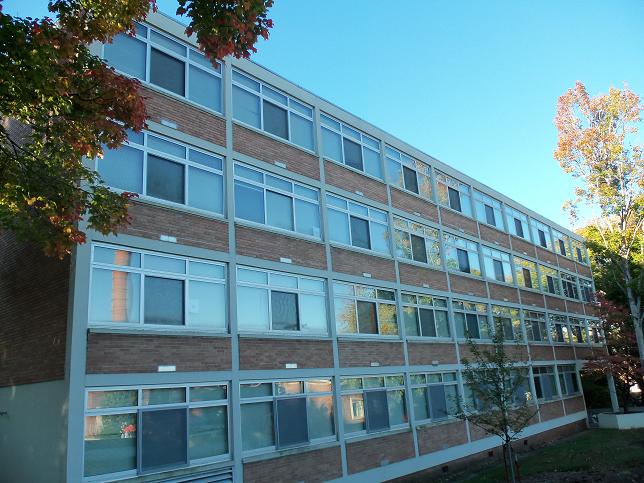
Sirrine Hall, home to the Econ Department:

Here’s Cope Hall, where I met my archnemesesdear friends Mole (first conversation: “Excuse you.”), DFJ3 (“Which room is the shaggy haired guy in?”, a reference to Mole), Dr. Hmnahmna (“Are you a grad student or something?”), Scott (I don’t remember our first conversation, but I remember my first conversation with his girlfriend, which I won’t repeat here), Major Patton (Me: “Is Simon [the RA] in?” Him: “I’m sorry, I’ve retired for the evening.”), Robert (probably something bizarre and rambling that formatted my brain), Aabrock (probably something football related due to time spent in the lounge), and Brundgren (he talks so rarely I think we haven’t actually completed our original discussion). Apologies to those I omitted; it is sheer forgetfulness. I was on the top floor, third from the left. Used to have a bunch of sodas duct-taped together, hanging out the window in winter.

My dorm was right next to Fort Hill, one-time home of none other than rabble-rouser-in-chief John C. Calhoun. The story was that if you entered the mansion, you’d never get your degree. I toured the place two hours before graduation.

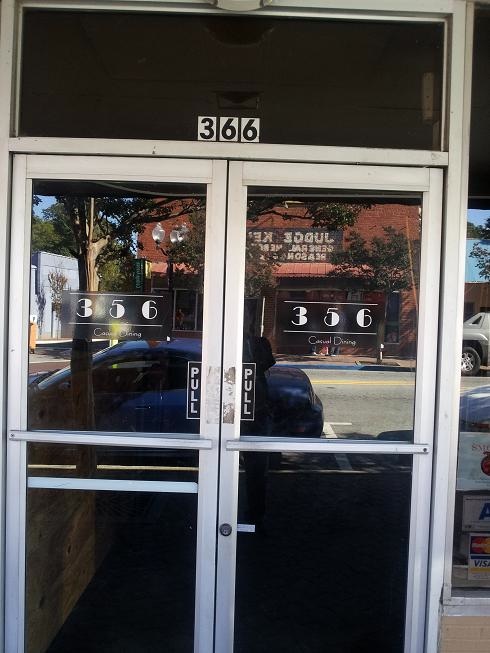
Then off to downtown. The Astro was still closed, the Newsstand hadn’t miraculously come back, this dinky little restaurant had still misappropriated the proposed name of my buddies’ coffee shop, “356.” The bastards even stole the font. Look carefully at the picture and eventually you’ll see the biggest problem.

Thank God Nick’s was the same, and open, and serving French dip sandwiches and Woodchuck for breakfast:

This picture should not be interpreted as an endorsement of Shiner.

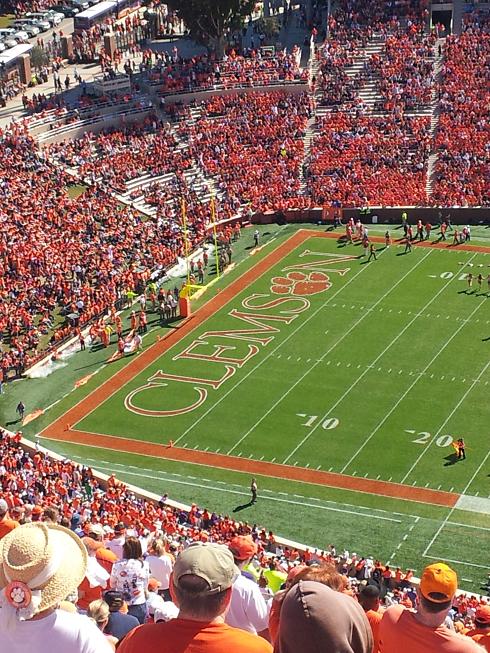
I only got three decent shots in the stadium. Here’s the east end zone, with members of the 1981 championship team walking onto the field:

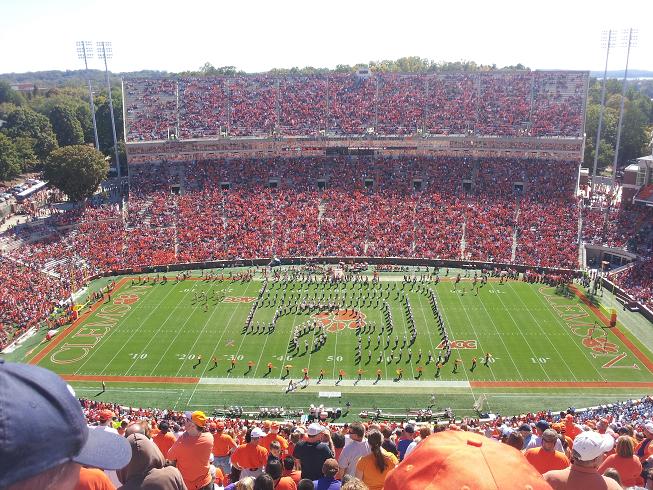
Here’s the marching band, forming the famous flaming toilet bowl:

It’s upside down from my perspective, so either flip your laptop or yourself over and the nickname for this particular logo will make more sense.

It occurs to me that the evidence is at least partly disputable because I didn’t post any pictures of my pals. I’ll photoshop them in later.

Someone didn’t learn.

In the wake of Saddam’s execution, almost five years back, I wrote:

However history judges either aspect of the execution, I hope for at least one small benefit: that the next would-be tin-pot dictator sees this grainy, graphic, grotesque reminder of what could happen when his people get hold of him, and chooses a more benevolent path.
–Me, _ _ _ _    _ _ _ _ _ _ , January 2, 2007

Gruesome footage of Gaddafi’s final moments were posted online (please note that the link leads to a violent video intended only for a mature audience). Hard to believe that of those Beirut conspirators, only Fidel and Gorby remain. The boogeymen of the 1980s are dropping like flies.

I worry that the Libyan and Egyptian revolutions are going to go the way the Iranian one did in 1979. Hopefully events will assuage my concerns.

On the GOP field, part two.

An anonymous reader recently asked: “What is your honest opinion of each of the GOP candidates for president?” Last week I wrote about seven of the nine major Republican candidates before succumbing to a massive headache. Here’s my take on the last two, in alphabetical order:

Gary Johnson: He has gubernatorial experience, he seems unassuming, and he has promised to veto any budget that is not balanced. Given that recent budgets have seen a 40-45% gap between revenues and expenditures, that promise may seem unrealistic. It is a sad sign of the times that the promise is unrealistic, and perhaps sadder that he’s the only one willing to make it. He’s got two big problems, aside from a near-total lack of name recognition. First, in recent interviews he has seemed exasperated that he wasn’t getting more attention and that he was being left out of the debates. No matter what the message is, exasperated won’t score any points. His second and larger problem is that there’s already a candidate who’s staked out the libertarian wing of the party, named…

Ron Paul: He’s got the name recognition he was missing last time around, he’s more consistent than the other Republicans, he’s energetic enough to overcome his age problems, and he (and current events) have made the Austrian school much more popular in recent years. The bad news is that he can come across as a wacky old man, nobody likes a Cassandra, and the electorate will find his foreign policy to be isolationist and unrealistic. The whole “being right about the recession” thing probably won’t be enough to get him the nomination.

They both have another problem: they keep talking about what government shouldn’t do. That’s generally not a good way to win nominations, never mind national elections.

Anyhow, right now I think that Romney’s the most likely to win the nomination. He’s doing well enough in the polls, he’s raised all kinds of money, and the GOP has a habit of nominating candidates who came close to winning earlier primaries (Nixon lost in 1960, Reagan lost in 1968 and 1976, Bush 41 and Dole lost in 1980, Bush 43 is an exception, but can be seen as a re-nomination of his dad, McCain lost in 2000, Romney lost in 2008). But the voting is still a few months away, and anything can happen.

On the GOP field, part one.

Last week, an anonymous reader asked: “What is your honest opinion of each of the GOP candidates for president?”

Four years ago at this time, I thought that either Romney or Fred Thompson would win the Republican nomination, that the GOP would seriously consider Giuliani as a Presidential candidate, that McCain would flame out early in the Republican primaries, that Edwards would end up in jail sooner or later, that Obama was trying to position himself for a 2016 run, and that Hillary was a lock for the Democratic nomination. I was wrong about five of those predictions, but Johnny Boy is under indictment, so… fingers crossed. You never know how the game’ll play out, so take my comments with a grain of salt. I shall proceed alphabetically.

Michele Bachmann: First time I’ve seen her in a debate. She performed better than I expected, but she treated the whole affair as a one-on-one Q&A session that happened to have seven other candidates at the table. I didn’t sense any real personal engagement– not friendship, not animosity, nothing– between her and the moderators, or between her and the other candidates. It was strange. A Bachmann-Obama debate might just be weird enough to throw Obama off his game, but I doubt it.

Herman Cain: He’s politically unpolished, not up to speed on some of the big foreign policy issues (by his own admission), but he gives the impression that he’d be a quick study. Nothing seems to have fazed him yet, and in tonight’s debate he had a comeback to every attack thrown at him. He won’t get “9-9-9” through Congress, and I think that Bachmann’s, Paul’s, and Santorum’s concerns about the plan are valid. I think he could beat Obama in a debate: he seems more than sharp enough to overcome any rhetorical attack from Obama, he’s personable, folksy, optimistic, and if necessary he can shrug off some of the attacks on his lack of government experience by pointing to his time as Chairman of a Federal Reserve Bank. Some folks felt that Hillary and McCain treated Obama with kid gloves for fear of having the race card played against them; Cain doesn’t have to worry about that and will tee off on Obama.

Newt Gingrich: Newt may be the smartest guy in the room, but he can’t focus. I think he’d be a Republican Jimmy Carter, micromanaging every little detail and somehow managing to ruin all of them. Speaker of the House was the ideal position for him: he seemed like an effective legislator. Tragically– well, not “tragically,” it’s not like he couldn’t avoid it– he cheated on his second wife with his third wife while going after Clinton during Monicagate. Granted, Newt didn’t lie about it under oath, but it didn’t happen so long ago that it’s easily forgotten. I haven’t forgotten, anyways. Another early dropout.

Julianna Goldman: She doesn’t seem to understand what “hypothetical” means, but she’s really good looking, thirty-ish, her dad’s a bigtime DC lawyer, and she’s recently single. I think she’s got promise, and I’m gonna– hold on a second.

…my editor says she was a moderator and not a candidate for President, and that I should move on.

Jon Huntsman: I don’t trust this guy. Something about him reminds me of John Edwards, but I can’t quite place my finger on it. Also, don’t we already have a center-right Mormon governor with some lefty sympathies in the race? And hasn’t that territory already been staked out? No shot at winning the nomination, another early dropout.

Rick Perry: I know all about the deconstruction of Perry’s economic record, but the fact remains that Perry’s Texas gained jobs while Obama’s America lost them. You can only dance around that so much. If Rick Perry gets the nomination, he needs to hope that people ignore the debates and focus on his record. Obama needs to hope that people ignore his record and focus on the debates. Without some serious coaching, Perry will look bad in the debates next fall.

Mitt Romney: He looks, sounds, and acts like he was genetically engineered by a cabal of mad scientists for the sole purpose of winning the Presidency (though I’d also buy that he was a cyborg). He’s got the political experience and machinery to win the nomination and the general election. And he’s slick: he gets to ask one question of one of his rivals, and he asks… Bachmann! He lobs her a softball to make her look good, which might revitalize her campaign just a little bit, which’ll keep the right wing of the party divided while the centrist wing congeals around Romney. He will be as prepared as anybody to beat Obama in the debates next fall, and he’s capable of making Obama look weak and stupid. However, I don’t think Romney can pull off “folksy” as well as Obama can, and Romney probably won’t have the same full-throated GOP support that a Perry or a Cain would.

Rick Santorum: He seems like a decent guy, he makes a good point about the link between poverty and broken homes, but he’s locked into restoring America’s manufacturing sector in a time when the economy is pushing new sectors. Worse, he’s let himself get caught up in an ugly snit with Dan Savage– I won’t elaborate further. Worse worse, he seems bitter that he’s not getting as much attention as other folks, and nobody likes bitter (my life is a testament to such). He’s about a month away from acting completely resigned to losing, and I think he’ll drop out after Iowa.

Due to a smashing headache, I’m going to stop there for the night. The last two guys, Gary Johnson (who wasn’t invited to tonight’s debate) and Ron Paul, are different enough from the other seven that they deserve their own separate treatment. I’ll continue tomorrow.